A JOURNEY OF SEEING
The Hidden
Harmony.
The complete text and photographs of the research.
Stages of the story +
OPENING
What remains of our humanity?
We live in a time that seems to offer no respite. The wounds inflicted on the earth, wars and the rapid changes in technology run through our days, while our ways of living, seeing and relating to one another are changing.
Around us, noise grows and images multiply. Yet beneath this agitation I continue to sense the presence of something that cannot be swept away: a possibility of balance inscribed in reality and perhaps in our consciousness too.
It has not disappeared. Rather, we have lost the ability to listen for it.
THE BEGINNING
It began with walking.
My photographic research began with an intuition, long before I could give it a name. It did not begin with a theory, or a desire to prove an idea. It began with walking.
In city streets, along the sea, among walls, houses, fields and human-made architecture, I would sometimes sense that things, while remaining exactly what they were, had briefly slipped free of the familiar.
The world did not become different: it allowed itself to be seen differently.
WAITING
Reality holds connections.
In this way I learned that reality holds connections that do not reveal themselves to an impatient gaze. To recognise them, we need to slow down, relinquish for a while the desire to find, and allow things to come towards us.
This takes time, humility and an almost childlike openness to surprise. There is also a form of play in this waiting: the freedom to follow an unexpected call, to change direction, to let a wall, a shadow or a patch of sky surprise me.
HARMONY
Differences, tensions and relationship.
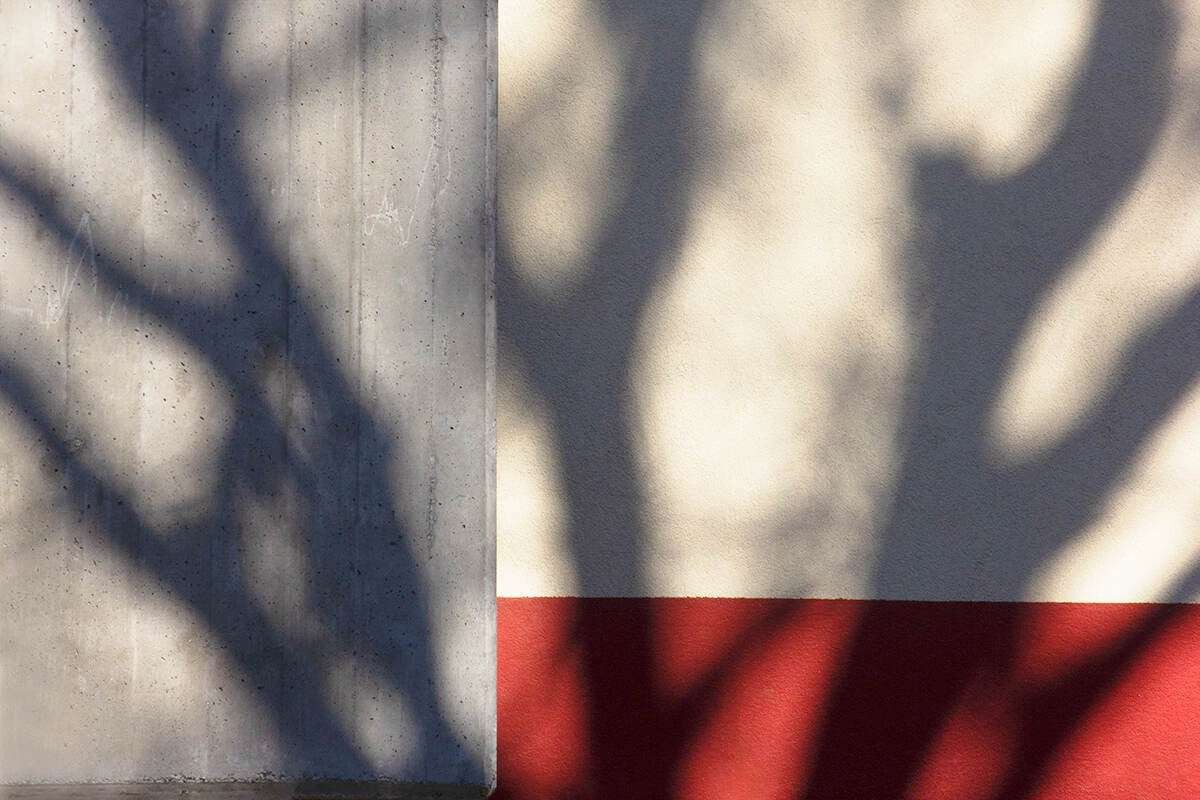
The harmony I seek is not simply what is pleasing or free of tension. It arises when different elements enter into a relationship without losing their identity. A line has no value in isolation, nor does a colour hold a meaning on its own: each finds its voice in the presence of the others. Oppositions, distances, collisions and empty spaces can also belong to the whole.
Unity does not ask differences to fall silent; it welcomes them and gives them a place. This is why peace, as I understand it, is neither stillness nor the absence of conflict. It is the ability to keep our relationship with what differs from us alive.
When such a relationship offers itself to the gaze, photography can receive it. Through viewpoint and framing, fragments belonging to different objects and distant planes are brought into the unity of the photographic frame. Things remain what they are, yet their names and functions no longer exhaust their reality.
THE LANGUAGE
The abstract-real.
Lines, shapes and colours form the alphabet of photography; proportions, rhythms, tensions, solids and voids make up its syntax; light is what makes this silent writing legible.
I call this passage the abstract-real. It is neither an escape from the sensory world nor the arbitrary construction of an order foreign to things. It is an abstraction recognised in reality, one that truly existed before the lens. In the passage from spatial depth to the plane of the image, from object to structure, photography becomes more than representation: it becomes a way of knowing through forms and relationships, even before concepts.
A relationship encountered in the world may find a correspondence within the viewer and awaken something that already belongs to them, although it has remained unnamed. This is what I recognise in the principle of Equivalence. The meaning of the image does not arise from a symbol applied afterwards, but from its own visual structure. Harmony perceived in the world can thus become the visual equivalent of an inner possibility of peace.
THE ETHICS
Fidelity to reality.
What has been sensed must then be examined, selected, ordered and brought to its final form. Openness to the encounter and the discipline of making the work are two movements of the same breath.
The ethics of my work also follow from this need. If an image is to bear witness to a relationship encountered in reality, it must preserve its truth. I therefore retain the complete original framing of the RAW file; I do not use photomontage or interventions that alter the structure of the composition. The horizontal format is also a constant choice: the field in which my gaze has learned to seek measure, breathing space and relationship. These are simply the constraints I have recognised as my own: fidelity to the instant when the world and the gaze met.
For the same reason, titles indicate only the place and moment the photograph was taken. Each photograph should remain open, like a threshold. Viewers are not asked to decipher my thoughts, but to enter into a relationship with what they see and, through it, perhaps with a part of themselves that is still silent.
THE ROOT
Limits, spirituality and love.
There is also a more intimate root, without which this research would not be the same. My Christian perspective does not lead me towards devotional imagery or doctrinal statements. More simply, and more demandingly, it invites me to acknowledge limits, suspend judgement and welcome the world without claiming to master it. It reminds me that fraternity does not arise from feeling superior, but from recognising that we share the same vulnerability and the same aspiration towards a greater unity.
The spiritual, then, need not be sought in a realm apart from life. It may reveal itself in the simplest things and in the relationships the gaze recognises in reality. Everything can point beyond itself, provided that the gaze does not claim to define or possess the Mystery.
Perhaps it is precisely in this capacity of things to enter into a relationship that love becomes recognisable: a force that precedes us and moves through us, to which we can entrust ourselves because it calls differences into unity without erasing them. Through photography, as through other human languages, we may perhaps glimpse a trace of it, feel it resonate within us and recognise ourselves as part of the same relationship.
THE JOURNEY
An invitation to look.
I do not know whether the order I sometimes believe I recognise belongs to things, to the consciousness contemplating them or to their mysterious encounter. I know only that, when it reveals itself, it brings an attentive quiet, not an answer. For an instant, the world no longer appears as a sum of unrelated fragments, and I no longer feel that I merely stand before it. I am within the relationship I observe.
The Hidden Harmony bears witness to a possibility: that reality holds an order still capable of being recognised, and that through the experience of looking we may enter into a relationship with it once again. If these images and words leave something behind, I would wish it to be neither a theory to accept nor a method to imitate, but an invitation to look.
Harmony is not a perfection attained. It is a journey. Differences remain alive within it, and unity does not erase them: it recognises in each a necessary part of the whole. What may remain is the experience these images and words have awakened: the moment when someone, having contemplated them, returns to reality with greater openness, wonder and trust, and sees in another person not merely a limit to their own existence, but a presence necessary to that same unity.
CONTINUE THE JOURNEY